


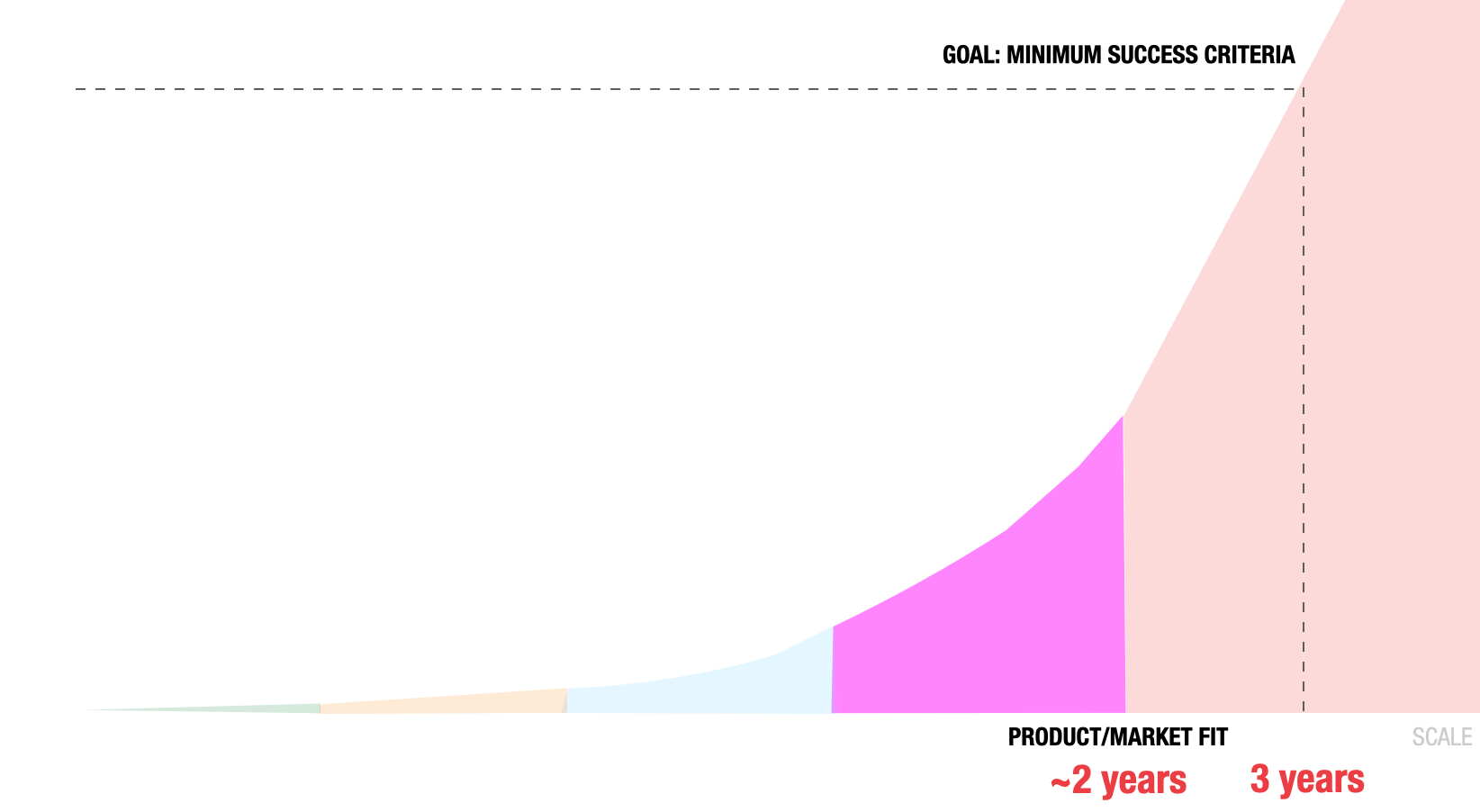
In the chaotic early days of a startup, most founders are flying blind. They have a vision, a deck, and perhaps a prototype, but they lack a definitive “North Star” that tells them if they are actually winning. Most define success as “getting funded” or “going viral,” but these are outcomes, not criteria.
Ash Maurya, the creator of the Lean Canvas and author of Running Lean and Scaling Lean, introduced a rigorous framework to solve this: the Minimum Success Criteria (MSC). It is a tool designed to strip away the “Innovator’s Bias” and force founders to define—in cold, hard numbers—what a business must achieve to be worth the effort.
The biggest threat to a startup isn’t the competition; it’s the founder’s own brain. Maurya often speaks about Innovator’s Bias, where an entrepreneur falls so deeply in love with their solution that they ignore evidence that the market doesn’t want it.
Without a predefined Minimum Success Criteria, founders tend to “move the goalposts.” If they hit 100 users instead of 1,000, they tell themselves, “Well, those 100 are really high quality!” The MSC prevents this “zombie startup” state—where a company isn’t growing enough to matter but isn’t failing enough to die.
Key Takeaway: The MSC is a “go/no-go” gauge. It defines the point at which you stop tinkering and either pivot significantly or double down.
Ash Maurya suggests that the MSC should be projected three years into the future. Why three years? Because it’s long enough to build something significant, but short enough to be tangible.
To calculate your MSC, you start with your end goal. For many venture-backed startups, the “success” mark is often cited as reaching a $10 million annual revenue run rate. For a lifestyle business, it might be $500,000.
The formula is deceptively simple:
Instead of trying to predict the future, Maurya advocates for “working backwards” from that 3-year goal. If you want to make $10M in three years with a product that costs $100/year, you need 100,000 customers.
A three-year goal is too distant to manage day-to-day. Maurya breaks the MSC into three distinct milestones that align with the life cycle of a startup:
Your goal in Year 1 isn’t to make $10M; it’s to prove that the “engine” works.
Target: Typically 10% of your Year 3 goal.
Focus: Problem/Solution Fit. Are people actually willing to pay?
Metric: Throughput of “Happy Customers.”
Year 2:
Target: Scaling the validated model.
Focus: Product/Market Fit. Can you find customers efficiently?
Metric: Lowering Customer Acquisition Cost (CAC) and increasing Lifetime Value (LTV).
Year 3:
Target: The full MSC (e.g., $10M).
Focus: Growth. Pouring fuel on the fire.
How do you actually sit down and write your MSC? Maurya suggests a “Traction Model” approach.
What is the one thing your customer does that signals they got value?
For Airbnb, it’s a night booked.
For Slack, it’s a message sent.
For SaaS, it’s a monthly subscription.
What does “worth it” look like to you? If you are taking investor money, this is usually dictated by the return they expect. If you are bootstrapping, it’s dictated by your desired lifestyle.
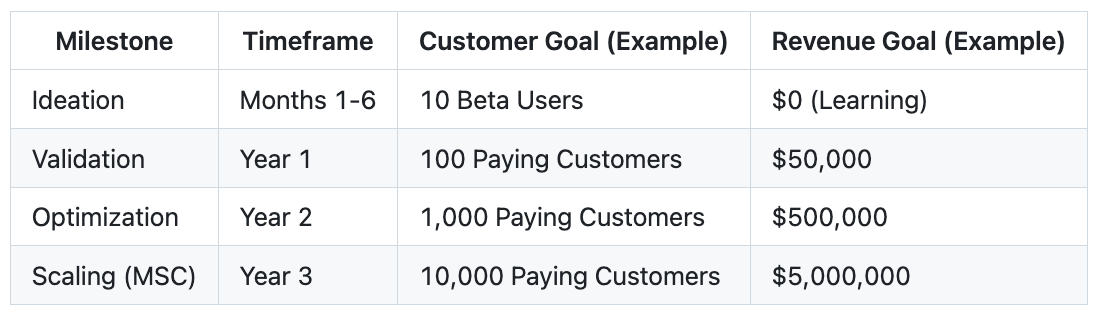
Use the following table to visualize the trajectory:
Traditional business plans are often 40-page documents filled with fictional five-year projections. Maurya’s MSC is the “lean” alternative.
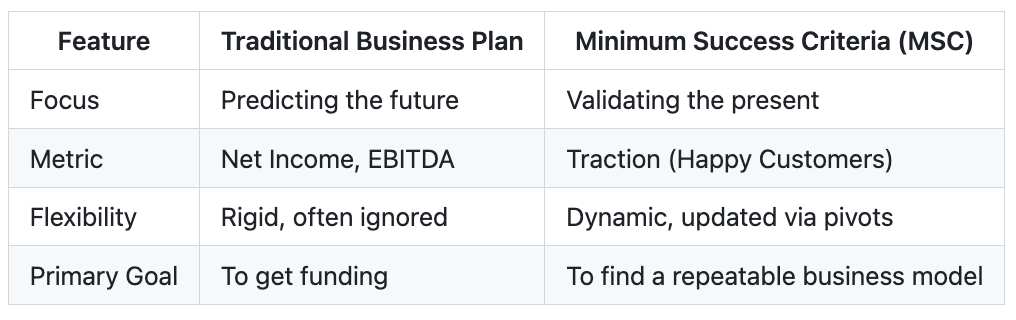
The beauty of the MSC is that it provides clarity during “The Pivot.”
When you run an experiment and the results come back lower than your Year 1 MSC requirements, you have three choices:
Persevere: If you believe the goal is reachable with minor tweaks.
Pivot: If the current path will never reach the 3-year MSC, you change a fundamental pillar (customer segment, pricing, or problem).
Reset: If no path to the MSC exists, you fold and move to a new idea.
“Life is too short to build something nobody wants.” — Ash Maurya
The MSC is the destination, but the Traction Model is the engine. Maurya suggests that once you have your MSC, you must model the “leaks” in your funnel.
If your Year 1 goal is 100 customers, and your trial-to-paid conversion is 10%, you know you need 1,000 people to start a trial. If your landing page converts at 5%, you need 20,000 visitors. Suddenly, your “success” is broken down into actionable marketing and product tasks.
Understanding Minimum Success Criteria is about moving from “vanity metrics” (likes, hits, downloads) to “traction metrics” (revenue, retention, referrals). By defining what success looks like before you get lost in the weeds of building, you give your startup a fighting chance.
The MSC isn’t a ceiling; it’s a floor. It is the minimum viable outcome that justifies your time, money, and emotional energy. As Ash Maurya advocates, don’t just build a product—build a business model that scales.